
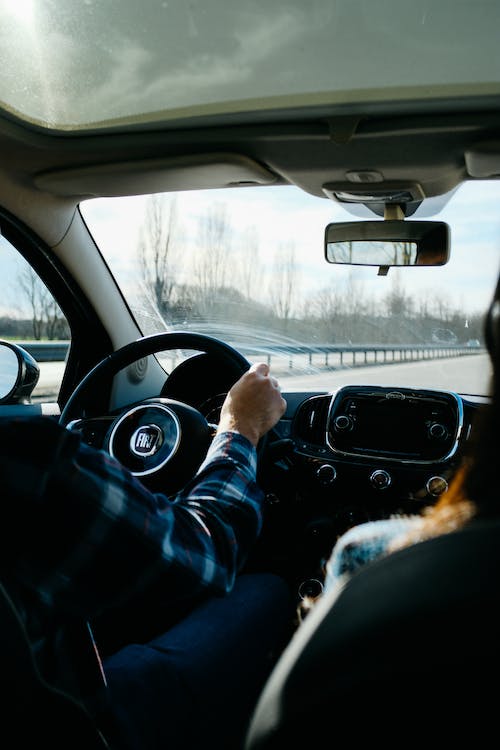
You know who you are. You’re in the passenger seat which has a front-row view of the highway before you. You are not in control. You’re either jumpy or panicked.
Depending on what happens in the driver’s seat, you may find yourself frantically stomping on a fantasy brake that exists only in your mind and your foot is only pressing down on, well, the floor of the car.
Sometimes you make little shrieking noises. Or your hand flies up to … what? Gesture weirdly? Grab the steering wheel?
You know your designated driver doesn’t like this behavior. But which comes first the chicken or the egg? Your behavior is a result of the driver’s driving. Right? But the driver doesn’t think his driving is a problem.
In fact, the driver has full confidence in his driving skill and is concentrating on getting from Point A to Point B as efficiently and effectively as possible.
Still, you find yourself telling your driver that there is something happening on the road up ahead. If it’s a person in the road you will calmly point that out. If it’s a dog in the road you will be gesturing and screeching at the top of your lungs, “No, n-o-o-o-, slow down! Look out for the dog!”
The driver then will say something like, “Yes, I see it, too. Because I am also watching the road. And do you know why? Because I’m driving!”
And sometimes Mr. Sarcasm will show up and add, “I don’t know how I get around in this car when you’re not with me.”
And that’s just the tip of the iceberg.
There are other problems. Speed limits. Curves. The car in front of you. The car you’re trying to pass. The needle on the gas gauge. The grip on the steering wheel.
Speed limits. You can MapQuest your destination and get the bonus feature of knowing what the speed limit is and how fast your vehicle is traveling. You don’t have to do anything obvious like leaning over to read the speedometer. You can just look at your phone. If the speed limit and the car speed are getting farther and farther apart, you will probably verbalize your concern. “The highway patrol usually won’t ticket you for anything up to 11 mph over the speed limit.”
So far so good. Then you say, “And we know from our DPS ride-along that 20 mph over the limit is considered criminal speeding.”
Now you’re entering the conversational danger zone. But you can’t stop now.
So, you finish up by saying, “And you need to slow down, Lead Foot.”
No, you don’t say Lead Foot. But you might as well have for the reaction you get.
Curves.
Driving instructors say you shouldn’t brake on curves and, in fact, you should “slow down appropriately” so you don’t need to brake during the curve. They also will tell you to accelerate only after you have safely driven through the curve.
Whatever. Your driver may either not know this or may not agree.
Thus, when you go through curves you may feel like you’re pulling G’s. This is what jet fighter pilots feel. Google says that pulling G’s is an extreme experience involving gravitational force, the ability of your body to regulate your blood pressure, and your inability to suppress the sounds coming out of your mouth.
The car in front of you.
You’re watching the gap close between the car ahead and the hood of your car. Your driver has the car set on cruise control and you know he doesn’t like to interfere with the cruise control setting. He set it on cruise control because you bugged him about the speed limit thing. So now you should be happy because you are doing the speed limit.
Regardless, the car in front of you is slower and you are quietly sitting in your passenger seat Googling “car lengths and speed” and yes indeed, it says right there on your screen that if your speed is 70 mph, you should be 103 feet or 23 car lengths behind the car in front of you.
What do you think happens next?
The car you’re trying to pass.
There’s no passing lane and there won’t be for the foreseeable future. You’re behind yet another massive slow-boat. You’re driving hills and curves and every so often there’s a straight-away stretch of road with the broken line that means you can pass. But usually there’s oncoming traffic.
This situation has been going on for miles and miles and your driver is getting impatient. Also, you can’t see what your driver sees because as a passenger you don’t have a view of the passing lane, which is grammatically ironic.
Anyway, this is never a good situation and you can count on the driver being as anxious as you are. He doesn’t want to be in an accident. You don’t want to pass at all.
Whoever speaks first is who starts the fight. Guaranteed.
The needle on the gas gauge.
How full is the gas tank? How far do we have to go? Are we going across Death Valley? Does it have a gas station? These questions used to be the focus of any “do we have enough gas” discussion. Now there’s the added excitement brought about by the price of gas.
Do we drive until we find a price we like? Do we put a couple of expensive gallons in the tank and hope we can get to somewhere with a lower price?
Gaming the Gas Needle. Fun for the whole family. The game that has no winners but is always in play.
If something catastrophic happens, for example you run out of gas in a remote location and are stranded for a good long while, you usually have less of a taste for playing this game. Otherwise, it’s a staple of any road trip.
The grip on the steering wheel.
Let’s say you like to hold the steering wheel with both hands. But you’re the passenger. The driver likes to hold the steering wheel with one hand (acceptable) or uses a lighter touch involving keeping a thumb and forefinger on the wheel (meh) or sometimes removes both hands to gesture (aaaaah!).
By now you have run the gamut of negative facial expressions, nervous vocalizations, and so forth and you are checking to see how many miles there are to your destination. And whether this place has a fully stocked bar.
ADVICE FOR WORRIED PASSENGERS
All this is to say that a Passenger recently asked me for advice. She had been in the car for awhile and was feeling stressy and was making her Driver stressy. She was looking for solutions and texted me, Madame Road Trip, with this question:
Dear Madame Road Trip,
Does Husband do most of the driving?
Passenger Person
MRT: Yes, he does. I offer to drive because I believe in 50-50 and I like driving but he usually says, “No, it’s OK.” So that frees me up to read my book or tell him random stuff. (He turns down the music and politely listens. Then we eat up a few miles of highway in contemplative silence. He turns up the music. Which triggers a thought in me and I begin to speak again. He turns down the music. Listens. And repeat. This is us on the road.)
Why? Do you ask about drive-sharing?
Passenger Person: Well, I don’t (like to drive), nor do I want to and I’m a terrible backseat driver (braking on the passenger side, turning my face, etc). Besides taking a Valium, do you have any tips on being a calm and good passenger?
Or else Husband is going to get a “Virtual Blinding Helmet” that hasn’t been invented, but he’s in the design phase. We need help urgently.
MRT: As long as there have been drivers and passengers there has always been the reflex action you describe. And as far as being a “terrible” backseat driver, I’m here to tell you it’s not something you ever get good at. The very nature of backseat driving is rooted in the disagreement over perception and reality.
Heavy sigh.
We all have different tolerance levels for highway speed, how to handle curves, proximity to the bumper in front of us, appropriate distance allowances for passing, number of fingers on the steering wheel, how much rain is necessary before windshield wipers are used, and so forth.
Valium, reading a book, playing Wordle (or any game on your phone), day-drinking, and sleeping are all good ways to take your mind off of what is happening on the road ahead of you and how the vehicle is being driven.
A Virtual Blinding Helmet ™ is an exciting prospect in finding a cure.
I wish I could offer more in the way of a concrete solution.
Perhaps expanding wedding vows to include:
“For better or for worse, in sickness and in health, and in all shared motor vehicle activity, ‘til death do us part.”

 The Upstory